
Space Governance Overview
Appalachian State University manages space and real property decisions through a structured, multi-committee process designed to ensure transparency, consistency, and alignment with institutional priorities and UNC System policies. The University assigns space to colleges and divisions. Space requests progress through three coordinated committees based on scope, cost, and complexity.
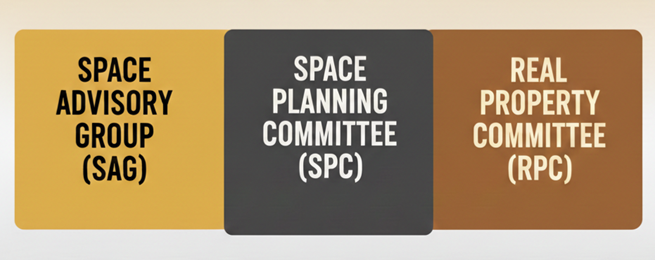
How are decisions made?
Space Management Guiding Principles:
Prioritize Existing Space: Exhaust all options to share, repurpose, and measure current space before requesting funds for buying, renovating, renting, or building.
Adhere to UNC System Policy: All space planning and requests must align with the UNC space utilization metrics. For current data, visit the Space Management dashboard on the IRAP website.
Evidence-based Decisions: Make all space requests based on measured usage rather than predicted, assumed, or historical usage.
Standard Allocation: Standard office space is calculated by multiplying the Adjusted Headcount (AHC), which accounts for remote, hybrid, and part-time status, by 130 square feet:
130 square feet x AHC = Assigned Square Feet
Justification for Under-Utilization: Departments performing below utilization goals must provide a robust, data-backed defense to justify any requests for additional space.
Strategic Placement: Priority support for specific requests may be given to units with ongoing in-person or public-facing mandates or roles.
Promote Shared Space: Committees actively support and prioritize the implementation of shared offices environments
Utilize the Lenoir Warehouse: The University’s 37,000 square foot warehouse in Lenoir must be fully utilized before any external storage space is considered.
Resources:
Academic Space Questions: Contact Adryona Nelson
Non-Academic Space Questions: Contact Melody Pineda
Office Change inFORM: https://appstate.az1.qualtrics.com/jfe/form/SV_9oxUaEcxX6ybGrc
For simple occupant updates or internal reassignments.
Space Request Form: https://forms.gle/CMDbGtU4S9XwqKGcA
For new space needs, renovations and change of use.
Planning, Design & Construction: https://pdc.appstate.edu/
Conference & Event Services: https://conferences.appstate.edu/
UNC System Policy on Real Property: https://www.northcarolina.edu/apps/policy/doc.php?id=745
Property Office: https://facilities.appstate.edu/facilities-operations/university-property-office